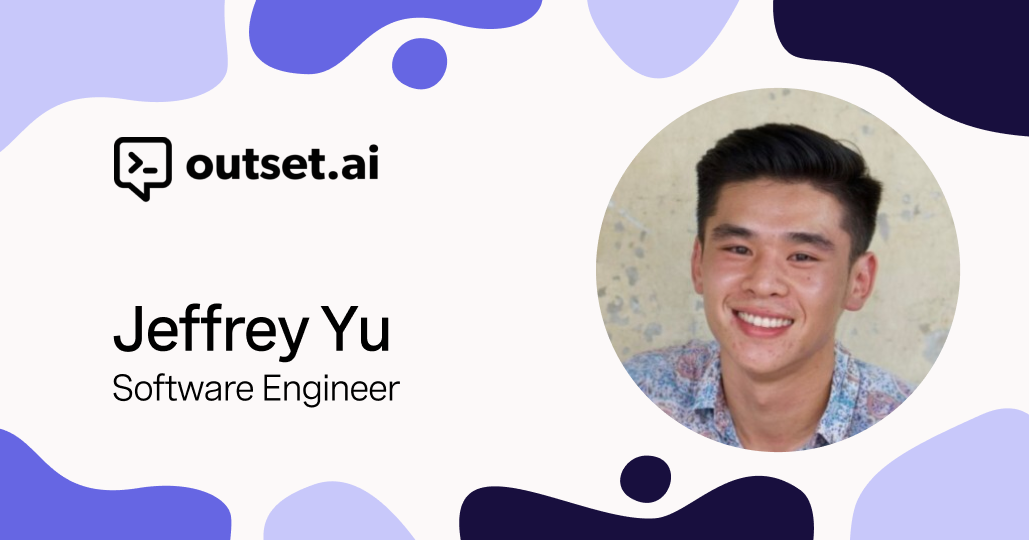
8VC Emerging Builders Spotlight: Jeffrey Yu (Outset)
Share


Share
At 8VC, we believe in backing companies who reimagine industries from scratch. When we led Outset's Series A, we saw the potential to completely transform user and market research with AI. Since then, their execution has been incredible. Outset scaled revenue rapidly, closed a Series B less than six months later after the Series A, and has dominated the market on AI-moderated research.
To understand the engine behind this velocity, we sat down with one of Outset's early engineers.
But we didn't actually conduct this interview. Instead, we used Outset's AI interviewer and let it run loose on one of its own engineers.
Tell us about Outset and why you decided to join.
Outset builds AI-moderated research. I came across the company two years ago on YC’s Work at a Startup board. Coming from a STEM background, I already understood how valuable research is, but I also knew how slow and painful traditional methods can be. Outset felt like a chance to rethink the entire workflow from first principles.
I joined largely due to the culture. It was clearly high-agency and deeply AI-native, which meant I wouldn’t just be using AI tools, but I’d be helping define what they could be. I really enjoyed my conversations with the founders, Michael and Aaron, as well as the broader team. While the team was clearly ambitious, I didn’t realize we’d end up building what’s now a category-defining AI research platform.
Today, our engineering team is loosely split between backend and frontend-leaning roles. In practice, everyone works across the stack. There’s very little process overhead: minimal meetings, no politics, just a strong bias toward building high-impact products.
What are you working on, and what does your day-to-day look like?
I was Outset’s first frontend hire, so I’ve architected the core interview and researcher experience. At this point, I’ve touched almost everything users see on the platform.
One of the most exciting parts of the role has been the freedom to build complex systems without layers of red tape—things that would normally take large teams months to ship. This includes:
- A fully multimodal interview experience spanning audio, video, and screen sharing
- A powerful in-browser video editor built entirely in-house
- Highly customizable analytics interfaces for researchers
- A companion mobile app for testing mobile websites and prototypes
On a typical day, we do a quick stand-up and then it’s mostly heads-down work. We move fast but are thoughtful, using AI tools to deliver maximum value to our customers. What keeps me motivated is that every line of code directly improves how researchers do their jobs.
One of Outset’s key differentiators is the ability to “go deep.” How do you architect an AI interviewer with human-level listening depth?
We started by studying how expert human researchers think. Then we decomposed the interview process into constrained interaction problems, separating what to ask from how to ask it.
There’s a supervisor layer that dynamically guides the agent. It can decide when to probe deeper, when to pivot topics, and how to adapt based on participant responses. That architectural separation lets us replicate the listening depth of a great human moderator—but with significantly more consistency and reliability.
Autonomous interviews are high-stakes. You can’t intervene once a session begins. How do you ensure reliability?
Reliability is everything, so we designed the system around a multi-agent architecture with layered safeguards. The interviewer is constantly constrained by configuration rules and behavioral checks.
Testing is just as important. We run prompt and model changes against hundreds of simulations. This ensures we get the desired behavior in critical scenarios before any code hits production.
When it comes to AI infrastructure, where do you use existing frameworks versus custom solutions?
We’re very pragmatic. For raw compute, we rely on off-the-shelf services like Azure and OpenAI. But for everything closer to the product surface, we’ve built custom systems.
We maintain our own orchestration layer so we can tightly control latency, error handling, and execution flow. We’ve also built a custom framework for interfacing with LLM APIs, tailored specifically to Outset’s product requirements. That balance lets us move fast without giving up control where it matters.
LLMs tend to be agreeable by default. How do you prevent the interviewer from just agreeing with users?
This largely comes down to system-level prompt engineering. We’ve built preset configurations that shape how the interviewer responds—encouraging neutral, probing behavior rather than validation or agreement.
We’re also actively working on tools that give researchers fine-grained control over the interviewer’s tone and persona. The goal is to ensure the AI behaves like a skilled moderator, curious, neutral, and rigorous, rather than a sycophantic conversational partner.
What’s been the most surprising thing you’ve learned working in this space?
People feel genuinely safe talking to a robot. It’s the same feeling you get the first time you step into a Waymo. Your background anxiety just switches off.
We’ve seen participants open up in ways they normally wouldn’t with a human moderator. Without fear of judgment, they share deeper, more honest insights. Realizing that we can build that level of trust, and do it at scale, has been one of the most meaningful surprises of this work.
What are you most excited about on the roadmap?
It’s hard to pick one, but there’s three things that we can’t wait to do:
- Giving our AI more visual intelligence, and therefore the ability to understand what it’s seeing, from user reactions and emotions to how people interact with prototypes.
- Creating fully autonomous agents that can design studies, recruit participants, run interviews, and analyze results end-to-end.
- Making high-quality research accessible to anyone at any company, not just teams with large budgets or specialized expertise.
If you enjoy the idea of building the machine that interviews the humans - and saves the rest of us from having to ask the questions - Outset is hiring.
Share
Continue Reading